

We start by looking at everything because everything matters.
Our clients’ goals are unique, specific and often, complex - which is why we perform a thorough assessment of each client’s financial picture. This way we can build a comprehensive plan that reflects personal goals and addresses precise needs. In fulfilling plan objectives, we deliver the elevated boutique experience our clients expect and decidedly deserve.

HOW IT WORKS
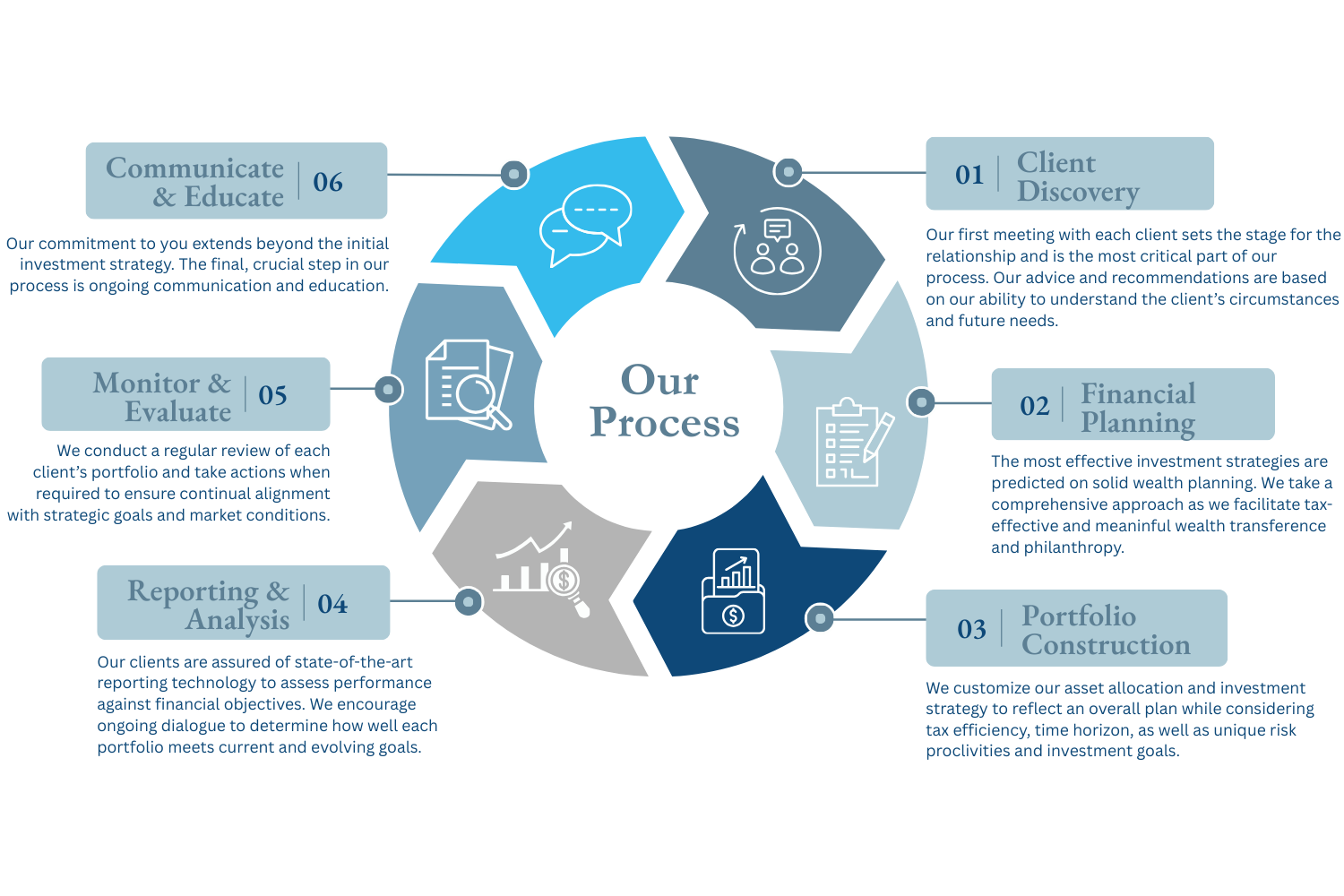
Our Process.
Because we view wealth management as a collaborative process, we create an environment characterized by proactive and consistent communications as we explore with our clients the various components of their plans.
We start by looking at everything because everything matters. Together, we take a detailed look at your finances, your lifestyle, and your goals. The result is a plan built around your objectives, designed to guide each step forward.


WHAT WE DO
Our Approach.
Successful investing does not require predicting markets, chasing trends, or identifying the next winning manager. Instead, it requires discipline, diversification, and a consistent focus on the factors investors can control. There are certain principles of investing that have been demonstrated across decades of academic research* and real-world market data:
Costs Matter
The lower the cost of investing, the more of the market’s return investors keep.
Most Active Managers Underperform
Over long periods, the majority of professional money managers fail to outperform their benchmark indexes after fees and expenses.
Performance Persistence is Rare
Managers who outperform in one period are unlikely to repeat that success in the next.
Asset Allocation Drives Outcomes
Long-term portfolio results are primarily determined by the mix of stocks, bonds, and other asset classes - not individual security selection.

Long-Term Thinking & Short-Term Flexibility.
In our view, relative total returns between asset classes are driven both by valuation in the long-term and by changes in fundamentals and investor psychology in the near-to-intermediate term. The careful blend of these two methodologies creates a decisive long-term strategy with the flexibility to drive shorter-term tactical differences in returns. Our allocation process begins with ‘science’ of analyzing historical market data. The ultimate decisions, however, are driven by the ‘art’ of interpreting the data through the filter of our experience and intuition. We believe this process allows us to focus better on making decisions that are logical and unemotional, particularly in highly uncertain markets.


Proactive & Reactive Risk Management.
We believe risk management is a critical discipline and employ a two-pronged approach (playing offense & defense) which strikes a balance between investor objectives and risk tolerance. Our proactive risk management is designed to help prevent an issue from happening in the first place. However, even the most carefully researched investments can fail to perform as expected. If this happens, our reactive risk management aims to mitigate the impact of unexpected events. This disciplined, unemotional process alerts us when an asset reaches a pre-determined threshold so we can take the appropriate action given the current conditions.
*Source: S&P Dow Jones Indices LLC, SPIVA U.S. Scorecard. Past performance is not indicative of future results.

Frequently Asked Questions.
-
We primarily use exchange-traded funds (ETFs) because they provide broad diversification, low costs, tax efficiency, and transparency. Decades of research show that minimizing investment expenses improves long-term outcomes. ETFs allow us to focus on the decisions that matter most - asset allocation, risk management, and discipline - rather than attempting to select individual securities or predict short-term market movements.
-
ETFs themselves are not inherently more or less risky than other investments - risk depends on what the ETF holds. However, ETFs often provide greater diversification, which can reduce the risk associated with owning individual securities. Many ETFs track broad indexes containing hundreds or thousands of holdings, helping manage company-specific risk within a portfolio.
-
In certain situations, we may incorporate actively managed strategies when we believe they offer a meaningful advantage, such as specialized asset classes or unique risk exposures. However, our default preference is for low-cost, rules-based investments because the evidence consistently shows that most active managers do not outperform their benchmarks over long periods after fees.
-
Strategic asset allocation is the long-term mix of stocks, bonds, and other investments designed to align with your goals, time horizon, and risk tolerance. It serves as the foundation of the portfolio.
Tactical allocation involves modest adjustments to that mix when market conditions, valuations, or risks change meaningfully. These adjustments are incremental and disciplined - not short-term trading or market timing.
-
Our primary objective is not to outperform a benchmark in any single year. Our goal is to help clients achieve their financial objectives with an appropriate level of risk.
We focus on capturing market returns efficiently while managing risk, costs, taxes, and investor behavior - factors that have a significant impact on long-term outcomes.
-
Most portfolios are designed to be long-term in nature and do not require frequent changes. We monitor portfolios continuously and may rebalance periodically or make adjustments when market conditions, client circumstances, or opportunities warrant.
Our philosophy emphasizes discipline rather than frequent trading.
-
While robo-advisors also use ETFs, our service goes far beyond portfolio construction. We provide personalized financial planning, tax-aware strategies, retirement modeling, behavioral coaching, and ongoing guidance tailored to each client’s situation.
Investment management is integrated with comprehensive planning rather than delivered as a standalone algorithm.
-
Tactical positioning cannot eliminate market risk or prevent declines. However, thoughtful adjustments may help manage exposure when risks become elevated or opportunities emerge.
Our goal is not to predict markets, but to respond prudently when conditions change while maintaining a disciplined long-term strategy.